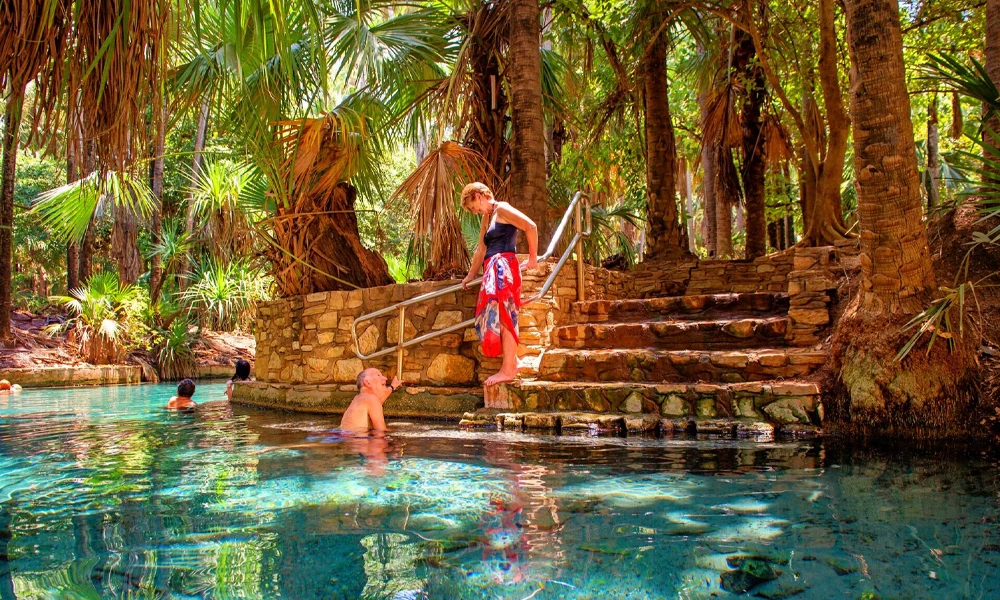
The Northern Territory’s landscape is dotted with natural wonders that have captivated visitors for generations, but few sites combine cultural significance, natural beauty, and historical importance quite like the Mataranka Thermal Springs. Located approximately 100 kilometers south of Katherine along the Stuart Highway, these crystal-clear pools nestled among tropical palms offer more than just a refreshing swim—they represent a living connection to both Indigenous heritage and European settlement history that spans thousands of years.
The Geological Marvel of Mataranka
The Mataranka Thermal Springs emerge from deep underground where ancient aquifers carry water through limestone formations, naturally heating it to a constant 34 degrees Celsius before it surfaces in a series of pools framed by paperbarks and pandanus palms. The Rainbow Spring, the primary source, pumps out approximately 30.5 million liters of water daily, creating the stunning azure pools that have become emblematic of this special place.
This natural phenomenon began forming millions of years ago when the region was covered by a vast inland sea. As the waters receded, the limestone formations created a complex underground system that continues to filter and heat the mineral-rich waters that emerge at Mataranka today. The striking blue coloration comes from the high mineral content, particularly calcium carbonate, which gives the waters their reported therapeutic properties.
According to geologists from the Northern Territory Geological Survey, the thermal springs are part of the larger Daly Basin aquifer system, one of Australia’s most significant groundwater resources. The water’s journey through these ancient formations can take decades, sometimes centuries, meaning the waters emerging today began their underground journey long before European arrival.
Dreamtime Significance: The Indigenous Connection
For the Mangarrayi and Yangman peoples, traditional custodians of the Mataranka region, the thermal springs hold profound cultural significance that transcends their physical properties. These waters feature prominently in Dreamtime stories that explain both the creation of the landscape and establish important cultural protocols for its use and protection.
One significant Dreamtime narrative tells of the Rainbow Serpent, known locally as Ganarrdji, who created the waterways throughout the region. As the serpent traveled across the land, it carved out rivers, waterholes, and springs, including the thermal pools at Mataranka. The warmth of the waters is said to come from the Rainbow Serpent’s body heat, left behind as a gift to the people.
Elder Jessie Garalnganjak Roberts, in her recorded oral histories with the Northern Territory Library’s Territory Stories collection, explains: “Those waters been sacred long time. Old people tell us Ganarrdji make that place for healing. When someone sick, those minerals make them strong again. We always know this place special.”
For thousands of years before European settlement, Indigenous communities would visit these springs during ceremonial periods and for healing purposes. The mineral-rich waters were believed to help with arthritic conditions, skin ailments, and spiritual renewal. Many of these traditional uses align remarkably well with modern therapeutic applications of mineral springs, demonstrating the sophisticated understanding Indigenous Australians developed of their environment.
Today, Traditional Owners work alongside Parks and Wildlife Commission NT to manage the springs, ensuring cultural protocols are respected while allowing visitors to experience this remarkable place. Cultural interpretive signs developed in consultation with Elders help educate visitors about the site’s significance beyond its recreational appeal.
European Discovery and Elsey Station
The European history of Mataranka begins with the establishment of Elsey Station in 1872, one of the Northern Territory’s earliest pastoral properties. The station would later achieve literary fame through Jeannie Gunn’s autobiographical novel “We of the Never Never,” published in 1908, which chronicled her experiences as the first white woman to live at the station.
Gunn’s vivid descriptions of station life and the surrounding landscape, including the thermal springs, introduced many Australians to the unique character of the Territory. Her writings depicted the harsh realities of outback life while capturing the beauty of places like Mataranka:
“A crystal-clear pool, fringed by massive-rooted palms and great spread of paperbarks, waters that held the warmth of the sun even as night fell upon them. The men declared it better than any man-made bath they had known.”
The historic Elsey Homestead has been reconstructed near the springs, allowing visitors to connect with this literary and pastoral heritage. The National Trust NT recognizes the site’s historical significance in the development of European settlement in the Territory.
During World War II, the springs took on yet another role in the Territory’s history when they became a recreation area for servicemen stationed at the nearby Mataranka Army Hospital. Many soldiers recovering from injuries or tropical illnesses found relief in the warm, mineral-rich waters—a therapeutic function that echoed the springs’ traditional use by Indigenous peoples.
Ecological Significance
Beyond human history, the Mataranka Thermal Springs support a unique ecological niche. The constant temperature and flow of water create microhabitats that differ significantly from the surrounding savanna woodland environment.
The spring-fed Waterhouse River, which flows from the thermal pools, supports riparian ecosystems that provide critical habitat for numerous species. The area around the springs hosts an abundance of wildlife, including wallabies, flying foxes, and over 100 bird species that have been documented by researchers from Charles Darwin University’s Research Institute for the Environment and Livelihoods.
Of particular ecological importance is the population of freshwater crocodiles (Crocodylus johnstoni) that inhabit the waterways around Mataranka. Unlike their more aggressive saltwater relatives, these freshwater crocodiles pose minimal risk to humans and form an important part of the local ecosystem.
The palm forest surrounding the main thermal pool is dominated by the Red Cabbage Palm (Livistona mariae), which creates a microclimate reminiscent of a tropical oasis. These palms are themselves living fossils, remnants from a time when the Northern Territory had a much wetter climate. Their continued presence around the thermal springs highlights how these constant water sources have preserved ecological niches that would otherwise have disappeared as the climate changed.
Environmental scientists are increasingly concerned about protecting the springs’ delicate ecosystem. Dr. Jenny Davis from the Australian Rivers Institute notes: “These thermal spring environments represent evolutionary refugia—places that have allowed species to persist through major climate change events. They’re time capsules of ecological history that warrant our strongest protection efforts.”
Challenges in a Changing Climate
Despite their ancient resilience, the Mataranka Thermal Springs face contemporary challenges that threaten their future. Increasing demands on the groundwater system that feeds the springs, primarily from agricultural development in the region, have raised concerns about sustainability.
Hydrogeological studies conducted by the Northern Territory Government have monitored fluctuations in water flow and temperature, detecting subtle changes that may indicate stress on the aquifer system. According to water resource specialists at the Department of Environment, Parks and Water Security, maintaining environmental flows is critical to preserving both the cultural and ecological values of the springs.
Climate change presents another significant challenge. With projections suggesting the Northern Territory will experience more extreme weather patterns, including longer dry periods, the pressure on groundwater resources will likely increase. This could potentially affect both the quantity and quality of water emerging at the springs.
Conservation efforts now focus on establishing sustainable limits for water extraction in the region and implementing monitoring programs that include Traditional Owner involvement. These initiatives recognize that protecting the springs requires managing the entire watershed, not just the visible pools themselves.
Visitor Experience and Tourism Impact
Today, the Mataranka Thermal Springs attract thousands of visitors annually, serving as a vital tourist destination that supports the regional economy. The main pool at Mataranka Homestead and the nearby Bitter Springs in Elsey National Park offer slightly different experiences, with Bitter Springs remaining closer to its natural state.
Tourism NT’s visitor statistics indicate that over 200,000 people visit the springs each year, contributing significantly to the local economy. For many traveling the Stuart Highway, the prospect of soaking in these soothing waters provides a welcome respite from the journey.
The challenge for site managers is balancing tourism access with conservation needs. Visitor infrastructure has been designed to minimize environmental impact while providing essential facilities. Elevated boardwalks protect sensitive vegetation around the springs, and designated swimming areas help manage human impact on the aquatic environment.
Collaboration between Parks and Wildlife Commission NT, Traditional Owners, and tourism operators has created educational programs that encourage visitors to appreciate both the natural wonder and cultural significance of the springs. This approach to tourism management helps ensure visitors leave with not just photographs, but a deeper understanding of the site’s importance.
For those interested in experiencing Mataranka, the Tourism NT website offers comprehensive information about access, accommodation options, and the best times to visit. The dry season (May to September) typically provides the most comfortable conditions, though the springs maintain their allure year-round.
Planning Your Mataranka Experience
If you’re considering a journey to explore the sacred waters of Mataranka, several accommodation options make it possible to spend more than just a day at the springs. The Mataranka Homestead Resort offers cabin accommodation and camping facilities within walking distance of the main thermal pool, while the nearby township of Mataranka provides additional accommodation options.
Visitors should respect the cultural significance of the site by observing all posted guidelines. Photography is generally permitted at the main swimming areas, but visitors should be aware that some nearby locations may have cultural restrictions. Always check with site managers if unsure about appropriate activities.
The best time to visit is during the dry season from May to October when temperatures are milder and access roads are reliably open. The Bureau of Meteorology provides up-to-date weather information for planning purposes, particularly important if visiting during the wet season when flash flooding can occur.
Preserving Mataranka for Future Generations
The enduring appeal of the Mataranka Thermal Springs lies in their ability to connect us with something ancient and profound—a place where geological processes, ecological relationships, and human cultures have intertwined for thousands of years. As visitor numbers grow and environmental pressures increase, the challenge of preserving this special place becomes more complex.
Conservation initiatives now incorporate both Western scientific approaches and traditional Indigenous knowledge systems. This collaborative management recognizes that sustainable protection of the springs requires understanding both their physical properties and their cultural significance.
Dr. Michael Douglas from the Tropical Rivers and Coastal Knowledge research hub emphasizes: “Places like Mataranka aren’t just natural features—they’re cultural landscapes shaped by thousands of years of human interaction. Effective conservation needs to address both these dimensions.”
Educational programs at schools throughout the Territory now include the study of thermal springs as living classrooms where students can learn about geology, ecology, and cultural heritage. By fostering appreciation among younger generations, these initiatives help ensure ongoing community support for conservation efforts.
The Mangarrayi Rangers, supported by the Northern Land Council, conduct regular monitoring of water quality and ecological health around the springs, combining traditional knowledge with contemporary science. This ranger program not only provides employment opportunities for local Indigenous community members but ensures that traditional custodianship continues in a modern context.
Recent archaeological studies conducted in partnership with the Australian Institute of Aboriginal and Torres Strait Islander Studies have documented evidence of continuous human occupation around the springs dating back more than 35,000 years. These findings further emphasize the need to protect not just the springs themselves but the surrounding cultural landscape with its rich archaeological record.
The story of Mataranka Thermal Springs continues to evolve as each new visitor discovers its wonders and each new generation inherits the responsibility of its stewardship. In a rapidly changing world, these ancient waters remind us of the deep connections between land, water, and human experience that define the Northern Territory’s unique character.
Whether you come seeking healing waters, a refreshing swim, or a deeper understanding of the Territory’s complex heritage, the sacred waters of Mataranka offer an experience that resonates long after you leave their embracing warmth—a living treasure of the Northern Territory that continues to nurture body, mind, and spirit just as it has done for countless generations before us.